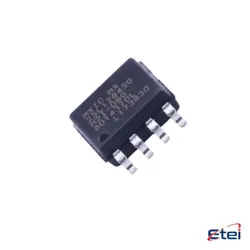
Hình ảnh chỉ để tham khảo
AD633JR
+BOMIC ANALOG MULTIPLIER 8-SOIC
-
Nhà sản xuấtCông ty Analog Devices Inc.
-
Ông. Phần #AD633JR
-
Bảng dữ liệu AD633JR DataSheet
-
Gói 8-SOIC
-
Có sẵn3946
365 Đảm bảo chất lượng ngày
7*24 giờ dịch vụ quarantee
90-Bảo hành sau bán hàng ngày
Bảo hành sản phẩm chính xác
Thông số kỹ thuật
| thuộc tính | Giá trị |
| Package | Bulk,Tube,Tube |
| ProductStatus | Obsolete |
| Function | Analog Multiplier |
| NumberofBits/Stages | 4-Quadrant |
| Package/Case | 8-SOIC (0.154, 3.90mm Width) |
Tổng quan
Description
Key features of the AD633JR include a low total error, typically around 2%, and a bandwidth of approximately 1 MHz, allowing it to handle a wide range of signals. It operates from a dual supply voltage, typically ±15V, and can handle input levels within these voltage ranges. The chip also includes a differential multiplier design, which helps in minimizing signal distortion and enhancing accuracy.
The AD633JR is often used in audio processing, communications systems, and instrumentation. Its compact and efficient design makes it an ideal choice for engineers looking to implement precise analog multiplication in their projects.
Equivalent
1. AD633AN: Another version of the AD633 with different packaging.
2. MPY634KP: A four-quadrant analog multiplier from Texas Instruments.
3. AD534: A similar product from Analog Devices with more features.
4. MC1494: A balanced modulator/demodulator from ON Semiconductor.
5. LM13700: An operational transconductance amplifier with multiplier capabilities from Texas Instruments.
These alternatives vary in specifications and packaging, so ensure compatibility with your application.
Features
1. Four-Quadrant Multiplication: It can perform bipolar signal multiplication, handling both positive and negative inputs effectively.
2. Voltage Gain: The device offers a nominal gain of 1, simplifying the design process since external components aren't needed for gain setting.
3. High Linearity: The AD633JR provides a total error of typically less than ±2% of full scale, ensuring precise operations.
4. Wide Bandwidth: With a bandwidth of around 1 MHz, it is suitable for a variety of signal processing applications.
5. Low Power Consumption: It's designed for low power applications, with typical power consumption being modest.
6. Single or Dual Supply Operation: It supports both single and dual supply configurations, enhancing flexibility in circuit design.
7. Compact Package: The IC is available in an 8-pin SOIC package, making it easy to integrate into space-constrained designs.
These features make the AD633JR suitable for applications like modulation, demodulation, and other analog signal processing tasks.
Pinout
1. Pin 1 (X1): Input for the first operand of the multiplier.
2. Pin 2 (Y1): Input for the second operand of the multiplier.
3. Pin 3 (Z): Offset or summing input; used to add a separate voltage to the multiplication product.
4. Pin 4 (-VS): Negative power supply voltage.
5. Pin 5 (W): Output of the multiplication operation.
6. Pin 6 (+VS): Positive power supply voltage.
7. Pin 7 (Y2): Second input for differential operation, typically grounded or used for differential input.
8. Pin 8 (X2): Second input for differential operation, typically grounded or used for differential input.
The AD633JR is used in applications requiring precise multiplication of analog signals, such as modulation, signal processing, and control systems.
Manufacturer
Application
1. Signal Processing: It's used for amplitude modulation and demodulation, phase detection, and frequency mixing.
2. Audio Processing: Utilized in audio effects like ring modulation and dynamic range compression.
3. Servo Systems: Helps in creating control loops for precise motion control.
4. Instrumentation: Used in creating signal conditioners and analog computational circuits.
5. Voltage-Controlled Amplifiers: It enables variable gain amplification in audio and RF circuits.
6. Modular Synthesizers: Found in voltage-controlled oscillators and filters for sound synthesis.
These applications leverage the AD633JR's capability to perform accurate analog multiplications and other mathematical functions.