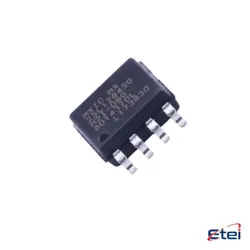
Hình ảnh chỉ để tham khảo
AD8400AR100
+BOMIC DGTL POT 100KOHM 256TAP 8SOIC
-
Nhà sản xuấtCông ty Analog Devices Inc.
-
Ông. Phần #AD8400AR100
-
Bảng dữ liệu AD8400AR100 DataSheet
-
Có sẵn9927
365 Đảm bảo chất lượng ngày
7*24 giờ dịch vụ quarantee
90-Bảo hành sau bán hàng ngày
Bảo hành sản phẩm chính xác
Thông số kỹ thuật
| thuộc tính | Giá trị |
| PartStatus | Obsolete |
| DigiKeyProgrammable | Not Verified |
| Taper | Linear |
| Configuration | Potentiometer |
| NumberofCircuits | 1 |
| NumberofTaps | 256 |
| Resistance(Ohms) | 100k |
| Interface | SPI |
| MemoryType | Volatile |
| Voltage-Supply | 2.7V ~ 5.5V |
| Tolerance | ±30% |
| TemperatureCoefficient(Typ) | 500ppm/°C |
| MountingType | Surface Mount |
| SupplierDevicePackage | 8-SOIC |
| Package/Case | 8-SOIC (0.154", 3.90mm Width) |
| OperatingTemperature | -40°C ~ 125°C |
| Resistance-Wiper(Ohms)(Typ) | 200 |
| BaseProductNumber | AD8400 |
Tổng quan
Description
Key features include a dual-channel design, allowing for simultaneous adjustment of two separate resistive loads, and an I2C-compatible interface for easy integration with microcontrollers and other digital systems. The device operates over a wide voltage range and offers low power consumption, making it ideal for battery-powered applications.
The AD8400AR100 also provides excellent temperature stability and linearity, ensuring accurate performance in critical applications. Its compact package and ease of use make it a popular choice for designers looking to implement programmable resistance in their circuits.
Equivalent
Features
1. Resolution: 256-position (8-bit) wiper control.
2. Communication Interface: Uses a 3-wire SPI interface for easy integration with microcontrollers.
3. Wiper Movement: Offers a non-volatile storage option to retain settings after power loss.
4. Voltage Range: Operates over a wide supply voltage range, typically from 2.7V to 5.5V.
5. Power Consumption: Low power consumption, making it suitable for battery-operated devices.
6. Resistance Options: Available in various resistance values, typically around 100 kΩ.
7. Temperature Coefficient: Features a low temperature coefficient for stable performance.
8. End-to-End Resistance: Provides a consistent and linear response across its range.
9. Package: Available in a compact SOIC package for ease of integration.
These features make the AD8400AR100 ideal for applications such as audio volume controls, sensor calibration, and adjustable gain settings in various electronic devices.
Pinout
Here is the pinout and function of the AD8400AR100:
1. VDD: Power supply pin.
2. GND: Ground reference.
3. A: Terminal A of the potentiometer.
4. B: Terminal B of the potentiometer.
5. W: Wiper terminal, providing an adjustable output.
6. SCL: Serial clock input for I2C communication.
7. SDA: Serial data input/output for I2C communication.
8. ADDR: Address pin for setting the I2C address.
The device features a 256-tap resistance ladder, allowing for fine control of resistance settings through digital commands.
Manufacturer
Analog Devices is known for its innovation in signal processing and data conversion technologies, focusing on enabling precise measurement and control in electronic systems. The AD8400AR100 is a digital potentiometer that facilitates applications requiring programmable resistance, including gain control, volume control, and sensor calibration. ADI's reputation for quality and reliability makes it a prominent player in the semiconductor industry. The company is headquartered in Norwood, Massachusetts, and operates globally, serving a diverse range of markets and customers.
Application
1. Audio Equipment: Volume control and tone adjustment in amplifiers and mixers.
2. Sensor Calibration: Fine-tuning sensor outputs in measurement systems.
3. Industrial Controls: Adjusting parameters in automation systems and process control.
4. Medical Devices: Calibration of equipment like insulin pumps and diagnostic machines.
5. Consumer Electronics: Volume and brightness control in televisions and audio devices.
6. Embedded Systems: Used in microcontroller-based designs for setting operational parameters.
Its digital control allows for precise adjustments and integration into various electronic systems.