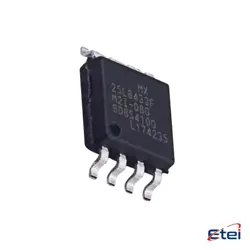
Hình ảnh chỉ để tham khảo
AD8400ARZ1
+BOMIC DGTL POT 1KOHM 256TAP 8SOIC
-
Nhà sản xuấtCông ty Analog Devices Inc.
-
Ông. Phần #AD8400ARZ1
-
Bảng dữ liệu AD8400ARZ1 DataSheet
-
Gói SOIC-8
-
Có sẵn4740
365 Đảm bảo chất lượng ngày
7*24 giờ dịch vụ quarantee
90-Bảo hành sau bán hàng ngày
Bảo hành sản phẩm chính xác
Thông số kỹ thuật
| thuộc tính | Giá trị |
| Package | Tube |
| ProductStatus | Active |
| Taper | Linear |
| Configuration | Potentiometer |
| NumberofCircuits | 1 |
| NumberofTaps | 256 |
| Resistance(Ohms) | 1k |
| Interface | SPI |
| MemoryType | Volatile |
| Voltage-Supply | 2.7V ~ 5.5V |
| Tolerance | ±33% |
| TemperatureCoefficient(Typ) | 700ppm/°C |
| MountingType | Surface Mount |
| SupplierDevicePackage | 8-SOIC |
| Package/Case | 8-SOIC (0.154, 3.90mm Width) |
| OperatingTemperature | -40°C ~ 125°C |
Tổng quan
Description
Key features include low power consumption, a compact 8-lead SOIC package, and solid temperature stability. The AD8400ARZ1 is suitable for a wide range of applications, including automatic gain control, parameter adjustments in filters and oscillators, and programmable power supplies.
Its non-volatile functionality is not available, meaning it does not retain the resistance setting after power down, which might be a consideration for specific applications. This device is commonly used in audio equipment, precision instrumentation, and other applications requiring precise digital control of resistance.
Equivalent
1. X9C103 by Intersil/Renesas
2. MCP41010 by Microchip Technology
3. DS1803 by Maxim Integrated
4. TPL0501 by Texas Instruments
These products may have differences in specifications such as resistance values, number of taps, and supply voltage, so verify compatibility with your specific requirements.
Features
1. Single-Channel: Provides a single-channel, 256-position variable resistor.
2. 10 kΩ Resistance: Offers a resistance range with a typical value of 10 kΩ.
3. Simple Interface: Features an SPI-compatible interface for easy integration with microcontrollers.
4. Low Power Consumption: Operates at low power, suitable for battery-powered applications.
5. Wide Operating Voltage: Supports an operating voltage range from 2.7V to 5.5V.
6. Compact Package: Available in a small SOIC (Small Outline Integrated Circuit) package for space-constrained applications.
7. High Linearity: Provides good linearity, enhancing performance in precision applications.
8. Non-Volatile Memory: Does not include non-volatile memory, meaning the wiper setting is lost when power is removed.
9. Temperature Range: Operates effectively over a temperature range of -40°C to +85°C, making it suitable for industrial environments.
These features make the AD8400ARZ1 ideal for applications requiring adjustable gain control, offset adjustment, and various other calibration tasks in electronic circuits.
Pinout
The primary function of the AD8400ARZ is to emulate the performance of a mechanical potentiometer, allowing for adjustments to be made digitally rather than manually. This makes it useful in applications where precise and reliable adjustments are needed, such as in calibration, gain control, or setting reference voltages.
Here is a brief overview of the pin functions:
1. VDD: Positive power supply.
2. GND: Ground reference.
3. CS: Chip select; enables the device for communication.
4. SDI: Serial data input; used for programming the potentiometer.
5. CLK: Clock input; controls data shifting in the serial interface.
6. SHDN: Shutdown; used to enable or disable the device.
7. VSS: Negative power supply or ground for dual-supply operations.
8. W: Wiper terminal; the adjustable output of the potentiometer.
This configuration allows the AD8400ARZ to integrate easily into digital systems for various electronic applications.
Manufacturer
Application
1. Volume Control: Used in audio equipment for digitally controlled volume adjustment.
2. Sensor Calibration: Provides precise calibration for sensors in measurement and control systems.
3. Automatic Gain Control (AGC): Utilized in communication systems to maintain consistent signal amplitudes.
4. Programmable Power Supplies: Allows fine-tuning of output voltages or currents.
5. Motor Control: Adjusts parameters in motor speed controllers.
6. Data Acquisition Systems: Improves flexibility in signal conditioning stages.
7. Offset and Gain Adjustment: Fine-tunes operational amplifiers and other analog circuits.
These versatile features make it suitable for a wide range of electronics in consumer, industrial, and communication sectors.