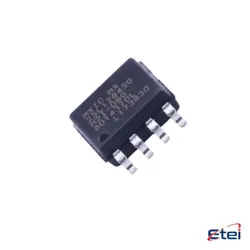
Hình ảnh chỉ để tham khảo
ATMEGA88PA-MMHR
+BOMIC MCU 8BIT 8KB FLASH 28VQFN
-
Nhà sản xuấtCông nghệ Microchip
-
Ông. Phần #ATMEGA88PA-MMHR
-
Bảng dữ liệu ATMEGA88PA-MMHR DataSheet
-
Có sẵn3910
365 Đảm bảo chất lượng ngày
7*24 giờ dịch vụ quarantee
90-Bảo hành sau bán hàng ngày
Bảo hành sản phẩm chính xác
Thông số kỹ thuật
| thuộc tính | Giá trị |
| Series | AVR® ATmega |
| Part Status | Active |
| Base Product Number | ATMEGA88 |
| Digi Key Programmable | Not Verified |
| Core Processor | AVR |
| Core Size | 8-Bit |
| Speed | 20MHz |
| Connectivity | I2C, SPI, UART/USART |
| Peripherals | Brown-out Detect/Reset, POR, PWM, WDT |
| Number of I/O | 23 |
| Program Memory Size | 8KB (4K x 16) |
| Program Memory Type | FLASH |
| EEPROM Size | 512 x 8 |
| RAM Size | 1K x 8 |
| Voltage - Supply (Vcc/Vdd) | 1.8V ~ 5.5V |
| Data Converters | A/D 8x10b |
| Oscillator Type | Internal |
| Operating Temperature | -40°C ~ 85°C (TA) |
| Mounting Type | Surface Mount |
| Supplier Device Package | 28-VQFN (4x4) |
| Package / Case | 28-VFQFN Exposed Pad |
| Packaging | Cut Tape (CT), Tape & Reel (TR) |
Tổng quan
Description
Key peripherals include 23 general-purpose I/O pins, a 10-bit ADC, USART, SPI, and I2C interfaces for communication, and timers/counters for precise timing operations. The ATMEGA88PA-MMHR uses the RISC architecture that allows instruction execution in a single clock cycle, enhancing speed and efficiency.
It supports a wide voltage range (1.8V to 5.5V), making it suitable for various applications, including consumer electronics, industrial automation, and home appliances. Its compact MLF/QFN package makes it ideal for space-constrained designs. The device is also backed by extensive development tools and a strong community, facilitating the design and prototyping process.
Equivalent
1. ATMEGA88-20AU: Similar functionality and architecture.
2. ATMEGA88P series: Variants with different packaging or power consumption features.
3. ATMEGA328P: Offers higher memory but with similar peripherals.
4. PIC16F88: An alternative from Microchip’s PIC series with comparable features.
5. STM8S003F3: A similar 8-bit microcontroller from STMicroelectronics.
These options may vary in specific features, so check compatibility with your requirements.
Features
Key features include:
- 23 general-purpose I/O lines for versatile connectivity.
- A total of 32 general-purpose working registers.
- Three timer/counters: two 8-bit and one 16-bit, supporting PWM and capture/compare modes.
- 10-bit ADC with up to 8 multiplexed channels for analog signal processing.
- SPI, I2C (TWI), and USART for communication interfaces.
- Watchdog timer with a dedicated on-chip oscillator.
- Programmable Brown-out Detection for safe operation.
- Power-saving modes such as Idle, ADC Noise Reduction, Power-save, Power-down, Standby, and Extended Standby.
The microcontroller is suitable for applications requiring low power and high performance, such as embedded systems and IoT devices.
Pinout
1. VCC: Supply voltage.
2. GND: Ground pins (usually multiple).
3. Port B (PB0 - PB7): General-purpose I/O pins, also used for SPI communication.
4. Port C (PC0 - PC6): General-purpose I/O pins, includes analog input capabilities (ADC).
5. Port D (PD0 - PD7): General-purpose I/O pins, also used for USART communication.
6. RESET: External reset pin.
7. XTAL1/XTAL2: Input/output for an external clock source.
8. AVCC: Supply voltage for the ADC.
9. AREF: Reference voltage for the ADC.
10. ADC channels: Part of Port C, used for analog-to-digital conversion.
The ATmega88PA-MMHR is suitable for tasks requiring low power consumption and efficient performance, like embedded systems and IoT applications. It is important to refer to the datasheet for detailed pin configurations and electrical characteristics.
Manufacturer
Application
1. Embedded Systems: Utilized in consumer electronics, home automation, and industrial control systems for processing tasks.
2. Automotive: Employed in vehicle control units and infotainment systems.
3. IoT Devices: Integrated into smart devices for connectivity and control functions.
4. Robotics: Used in motor control and sensor integration.
5. Wearable Technology: Powers fitness trackers and health monitoring devices.
6. Communication Interfaces: Facilitates data transmission in networking applications.
Its adaptability makes it suitable for numerous other applications requiring reliable and efficient microcontroller solutions.