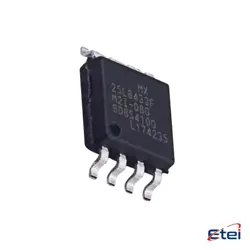
Hình ảnh chỉ để tham khảo
MAX232ESE
+BOMRS-232 DRIVER/RECEIVER
-
Nhà sản xuấtAnalog Devices Inc./Maxim tích hợp
-
Ông. Phần #MAX232ESE
-
Bảng dữ liệu MAX232ESE DataSheet
-
Gói SOIC-Narrow-16
-
Có sẵn6644
365 Đảm bảo chất lượng ngày
7*24 giờ dịch vụ quarantee
90-Bảo hành sau bán hàng ngày
Bảo hành sản phẩm chính xác
Thông số kỹ thuật
| thuộc tính | Giá trị |
| Package | Bulk |
| ProductStatus | Active |
Tổng quan
Description
The MAX232ESE contains dual drivers and dual receivers, which allow for bidirectional data transmission. It operates from a single 5V power supply, making it suitable for low-voltage applications. The chip incorporates internal charge pumps that generate the necessary voltage levels for RS-232 communication, specifically ±10V, which is standard for RS-232 logic levels.
Key features include a wide operating temperature range, low power consumption, and compatibility with various serial protocols. The MAX232ESE is widely used in embedded systems, communication devices, and various electronic projects requiring reliable serial communication. Its ease of use and efficiency make it a go-to solution for many engineers and hobbyists.
Equivalent
1. MAX202 - Similar functionality with lower supply voltage.
2. ST202 - A cost-effective alternative from STMicroelectronics.
3. TC232 - From Texas Instruments, also compatible.
4. ADM232 - An Analog Devices variant with low-power features.
5. SP232 - A cheaper option from Sipex.
Always verify pinout and specifications before replacement.
Features
1. Dual Driver/Receiver: Contains two drivers and two receivers for full-duplex communication.
2. Voltage Range: Operates with a supply voltage range of 4.5V to 5.5V.
3. RS-232 Compatibility: Converts RS-232 signals to TTL levels (±30V to +30V).
4. High Data Rates: Supports data rates up to 120 kbps.
5. On-Chip Charge Pump: Integrated charge pump for generating negative voltage, eliminating the need for external components.
6. Temperature Range: Operates across a wide temperature range from 0°C to +70°C.
7. Compact Package: Available in a 16-pin DIP and SOIC package for space-efficient designs.
8. Low Power Consumption: Designed for minimal power usage, making it suitable for battery-operated devices.
These features make the MAX232ESE ideal for serial communication in various electronic applications.
Pinout
1. V+ (Pin 1): Positive power supply input (typically +5V).
2. V- (Pin 2): Negative power supply input (typically -5V).
3. C1+ (Pin 3): Positive terminal of the first charge pump capacitor.
4. C1- (Pin 4): Negative terminal of the first charge pump capacitor.
5. C2+ (Pin 5): Positive terminal of the second charge pump capacitor.
6. C2- (Pin 6): Negative terminal of the second charge pump capacitor.
7. T1IN (Pin 7): Transmit data input from a microcontroller.
8. T1OUT (Pin 8): Transmit data output to RS-232 line.
9. R1IN (Pin 9): Receive data input from RS-232 line.
10. R1OUT (Pin 10): Receive data output to microcontroller.
11. T2IN (Pin 11): Additional transmit data input.
12. T2OUT (Pin 12): Additional transmit data output.
13. R2IN (Pin 13): Additional receive data input.
14. R2OUT (Pin 14): Additional receive data output.
15. GND (Pin 15): Ground reference.
16. NC (Pin 16): No connection.
The MAX232ESE is widely used for converting signals between TTL logic levels and RS-232 levels.
Manufacturer
As a company, Maxim Integrated focused on innovative semiconductor solutions, emphasizing high-performance and low-power products. It served a wide range of markets, enhancing device connectivity and performance through its high-quality ICs. In 2021, Analog Devices acquired Maxim Integrated, further expanding its portfolio in analog and mixed-signal technology, and strengthening its position in the semiconductor industry.
Application
1. Serial Communication: Interface between microcontrollers and RS-232 devices.
2. Modems: Connecting modems to computers or other devices.
3. Embedded Systems: Facilitating communication in embedded applications requiring serial data transmission.
4. Industrial Automation: Used in PLCs and equipment for data logging and monitoring.
5. Telecommunication: Enabling communication in telecom systems.
6. Point-of-Sale Systems: Connecting peripherals like printers and card readers.
Its ability to convert TTL/CMOS logic levels to RS-232 levels makes it essential in these areas.