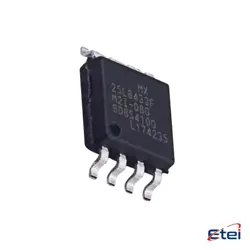
Hình ảnh chỉ để tham khảo
SN75LBC184P
+BOMIC TRANSCEIVER HALF 1/1 8DIP
-
Nhà sản xuấtTexas Dụng cụ
-
Ông. Phần #SN75LBC184P
-
Gói PDIP (P)-8
-
Có sẵn2849
365 Đảm bảo chất lượng ngày
7*24 giờ dịch vụ quarantee
90-Bảo hành sau bán hàng ngày
Bảo hành sản phẩm chính xác
Thông số kỹ thuật
| thuộc tính | Giá trị |
| Package | Tube |
| ProductStatus | Active |
| Type | Transceiver |
| Protocol | RS422, RS485 |
| NumberofDrivers/Receivers | 1/1 |
| Duplex | Half |
| ReceiverHysteresis | 70 mV |
| DataRate | 250kbps |
| Voltage-Supply | 4.75V ~ 5.25V |
| OperatingTemperature | 0°C ~ 70°C |
| MountingType | Through Hole |
| Package/Case | 8-DIP (0.300, 7.62mm) |
Tổng quan
Description
Key features of the SN75LBC184P include high noise immunity, low power consumption, and the ability to drive up to 32 unit loads on a bus. Its wide common-mode range and thermal shutdown protection enhance its reliability in harsh environments. The transceiver operates at data rates up to 250 kbps and supports a wide supply voltage range, typically 5V.
The SN75LBC184P comes in a standard 8-pin DIP (Dual In-line Package) configuration, making it easy to integrate into existing circuits. Its robust performance and compliance with industry standards make it a popular choice for industrial automation, networking, and telecommunications applications. Overall, the SN75LBC184P provides a reliable and efficient solution for differential signal transmission in various demanding environments.
Equivalent
1. Maxim Integrated: MAX485
2. Texas Instruments: SN75176B
3. Analog Devices: ADM485
4. STMicroelectronics: ST485
5. ON Semiconductor: NCS485
These alternatives offer similar functionality for applications requiring RS-485 communication. Always verify pin compatibility and electrical characteristics before substituting with another model.
Features
1. Differential Signaling: Supports RS-485 and RS-422 communication standards, providing robust noise immunity.
2. High Speed: Capable of data rates up to 10 Mbps.
3. Wide Supply Voltage Range: Operates from 4.75 V to 5.25 V.
4. Low Power Consumption: Offers reduced power usage with a low standby current.
5. Thermal Shutdown Protection: Prevents damage due to excessive power dissipation.
6. Short-Circuit Protection: Safeguards against accidental short circuits on the bus lines.
7. Wide Common-Mode Range: Allows reliable communication even with large potential differences between nodes.
8. ESD Protection: Enhanced electrostatic discharge protection for the device pins.
9. Driver and Receiver Enable Pins: Provides precise control of the device's operation mode.
10. Compact Package: Available in an 8-pin PDIP package, allowing for easy integration into designs.
These features make the SN75LBC184P suitable for industrial, automotive, and commercial applications requiring reliable data transmission.
Pinout
1. Pin 1 (R): Receiver Output - Provides the output of the receiver circuit.
2. Pin 2 (RE): Receiver Enable - Active low input to enable the receiver.
3. Pin 3 (DE): Driver Enable - Active high input to enable the driver.
4. Pin 4 (D): Driver Input - Accepts the data to be transmitted over the bus.
5. Pin 5 (GND): Ground - Common ground for the device.
6. Pin 6 (A): Non-Inverting Driver Output / Non-Inverting Receiver Input.
7. Pin 7 (B): Inverting Driver Output / Inverting Receiver Input.
8. Pin 8 (VCC): Supply Voltage - Powers the device.
The SN75LBC184P is commonly used for data transmission in industrial and commercial applications, offering features like thermal shutdown protection, low power consumption, and wide common-mode range.
Manufacturer
Application
1. Industrial Automation: Used for robust communication in harsh environments due to its noise immunity and ability to handle long cable lengths.
2. Network and Data Communication: Employed in RS-485 or RS-422 communication protocols for reliable data exchange over twisted-pair cables.
3. Building Automation: Facilitates control systems for lighting, HVAC, and security systems.
4. Telecommunications: Supports communication infrastructure by ensuring signal integrity over extended distances.
5. Embedded Systems: Implemented in microcontroller-based systems requiring reliable serial communication.
Its features make it suitable for high-speed and long-distance data transmission applications.